







Chinese EVs are making inroads in Singapore. Here’s why
Reading Time: 4 minutes
Jean Lau
Published: 4:46pm, 1 Aug 2025 | Updated: 8:21am, 2 Aug 2025
Singaporean financial adviser Winnie Koh faced a dilemma when selecting her family’s next car — she appreciated the value for money offered by Chinese electric vehicle (EV) brands, but still had lingering concerns about their quality.
But the 30-year-old said her experience driving a Tesla in the US raised doubts about the brand’s battery life and durability, leading her to consider Chinese rival BYD, which was offering incentives such as a 20 per cent discount on charging for three years and support for Singapore’s notoriously expensive Certificate of Entitlement (COE).
“It is Chinese technology, but that’s never really been the problem; the technology out of China has always been good,” she said, adding that her main concern was whether the manufacturers were cutting corners during production.
Koh eventually settled on a BYD in January for S$164,888 (US$127,000) and said she has been pleasantly surprised by its performance and features, including keyless start, a 360-degree camera system and assisted driving.
Her decision is emblematic of a broader trend on Singapore’s roads, where Chinese electric cars are quickly gaining traction and often surpassing traditional competitors from Japan, Europe and the US.
Winnie Koh with her BYD Atto 3. Photo: Winnie Koh
According to official data released on Monday, BYD emerged as the bestselling car brand in Singapore for the first half of 2025, with 4,661 new registrations, more than triple closest EV rivals Tesla’s 1,419 and far ahead of BMW’s 725.
The latest figures indicate that Chinese EV brands made up 31 per cent of new car registrations in the first half of this year, up from 22 per cent in 2024, 8 per cent in 2023 and 4 per cent in 2022.
According to Alberto Salvo, associate professor at the National University of Singapore, the influx of Chinese EVs was a “remarkable story” reflecting a mix of aggressive pricing, smart design and alignment with government policy.
Salvo, who is leading a study on EV adoption in Singapore, added that high public trust in the government’s Green Plan has also played a role in the switch to electric cars.
“Thus, when a car buyer looks for an EV, high-quality competitively priced Chinese brands are there for the taking,” he said, noting that Japanese, European and American manufacturers are racing to catch up.
Among the Chinese brands gaining ground are BYD, Dongfeng, Xpeng and GAC — all leveraging China’s economies of scale and home market dominance to compete globally.
“Chinese cars have really improved in quality drastically over the past decade” — Justin Tan, Dongfeng EV buyerSingapore’s COE system adds another layer of cost. Currently, the COE for smaller cars or EVs with a power rating up to 110kW is S$101,102. Rebates and lower sticker prices play a key role in affordability. Government incentives also matter. Under the Green Plan 2030, all new car registrations must be clean-energy vehicles. EV buyers can currently qualify for rebates up to S$40,000. Walter Theseira, an economics professor at SUSS, called it a “confluence of policy initiatives” that favoured Chinese EVs at the right time and price. He noted tax breaks of S$45,000 in 2021 and S$40,000 last year. Import taxes for Chinese EVs are also lower due to their lower export values, which further boosts affordability. He added that Chinese brands consistently deliver newer and more cost-competitive cars. “This is why other governments accuse China of selling cars below cost price,” he said. “But since Singapore has no home-grown car industry, the Chinese cars won’t have that problem here.”
Business undergraduate Justin Tan drives his Dongfeng Box. Photo: Justin Tan
In the first half of this year, 9.1 million EVs were sold globally, a 28 per cent increase from the previous year. China led with 5.5 million units, followed by Europe (2M) and North America (900K), according to Rho Motion.
Justin Tan, 23, shares a Dongfeng Box with his father, bought in February for its safety and price. Dongfeng launched in Singapore last September at around S$150,000. The Box offers a 430km range on full charge.
“We chose Dongfeng because it offered budget friendliness and great tech like auto parking,” he said. “As a new driver, I found the safety features ideal.”
“By then, Chinese cars were all over the roads and we thought there was no harm in trying one,” he added. “They’ve really improved over the past decade.”
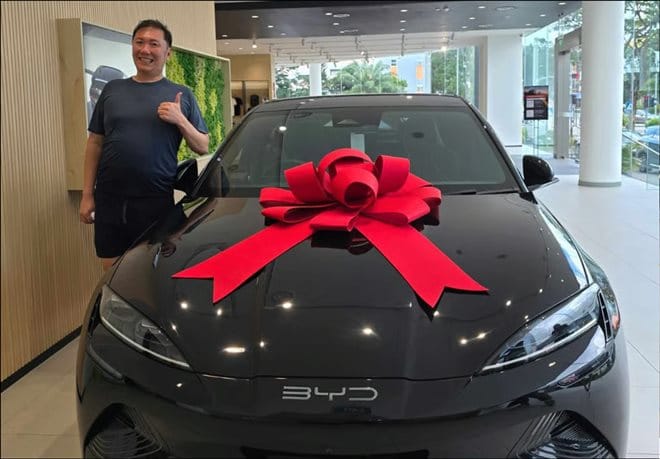
Property agent Tan Kok Hwee also bought a BYD Seal in February for S$170,000 after test-driving several cars in China. He said Tesla Model 3 felt uncomfortable and would cost S$8,000 more, while BMW iX1 cost S$90,000 more.
Tan Kok Hwee stands proudly beside his BYD vehicle. Photo: Tan Kok Hwee
“The BYD Seal feels safe and premium. The finishings aren’t cheap plastic; they’re velvety,” he said.
“In the past, people assumed Chinese products were poor quality,” he added. “But China now produces quality cars that even the US and Europe are wary of.”
Source: South China Morning Post